The One and a Half Kilometres That Shook a Nation
New Delhi: The roses came first. Then the tricolour. Then the tear gas.
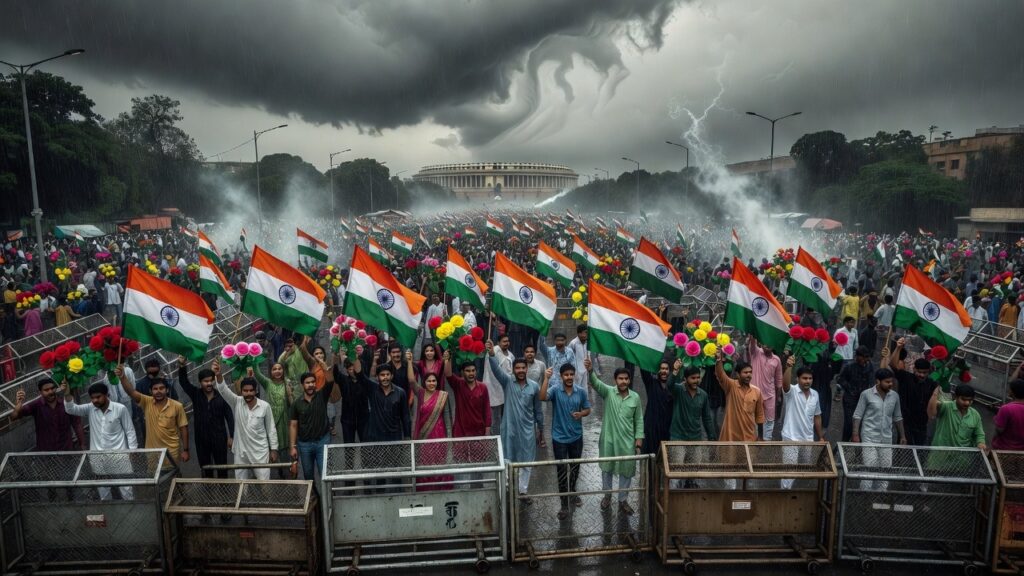
When thousands of young Indians stepped out of Jantar Mantar and began walking towards Parliament, they carried plastic roses in their hands. Some held portraits of Mahatma Gandhi.
Others clutched copies of the Constitution. Abhijeet Dipke, the 30-year-old founder of the Cockroach Janta Party, had told them the night before: carry roses, not weapons. If the police stop you, sit down. Do not jump the barricades.
The distance between Jantar Mantar and the new Parliament building is roughly 1.5 kilometres. It’s not a long walk.
You could cover it in 18 minutes on an ordinary day. But there was nothing ordinary about this day.
The monsoon session of Parliament had just begun. Inside, lawmakers were taking their seats. Outside, five metro stations had been shut down. Janpath. Rajiv Chowk. Patel Chowk. Central Secretariat. Seva Teerth.
Delhi Police had imposed prohibitory orders under Section 163 of the BNSS, barring gatherings of five or more people anywhere except the designated protest site at Jantar Mantar itself.

Riot police stood behind multi-layer barricades. Vehicles with riot gear lined the roads. Paramilitary personnel watched from every corner.
No permission had been granted for the march. Delhi Police said so, plainly, in a public advisory. The CJP said they would walk anyway.
They walked. The police met them with tear gas and baton charges. More than 10,000 protesters had gathered, according to Delhi Police’s own deputy commissioner, Sachin Sharma. CJP claimed the number was far higher. Many believe that more than 100,000 protesters gathered to express their disappointment with the government.
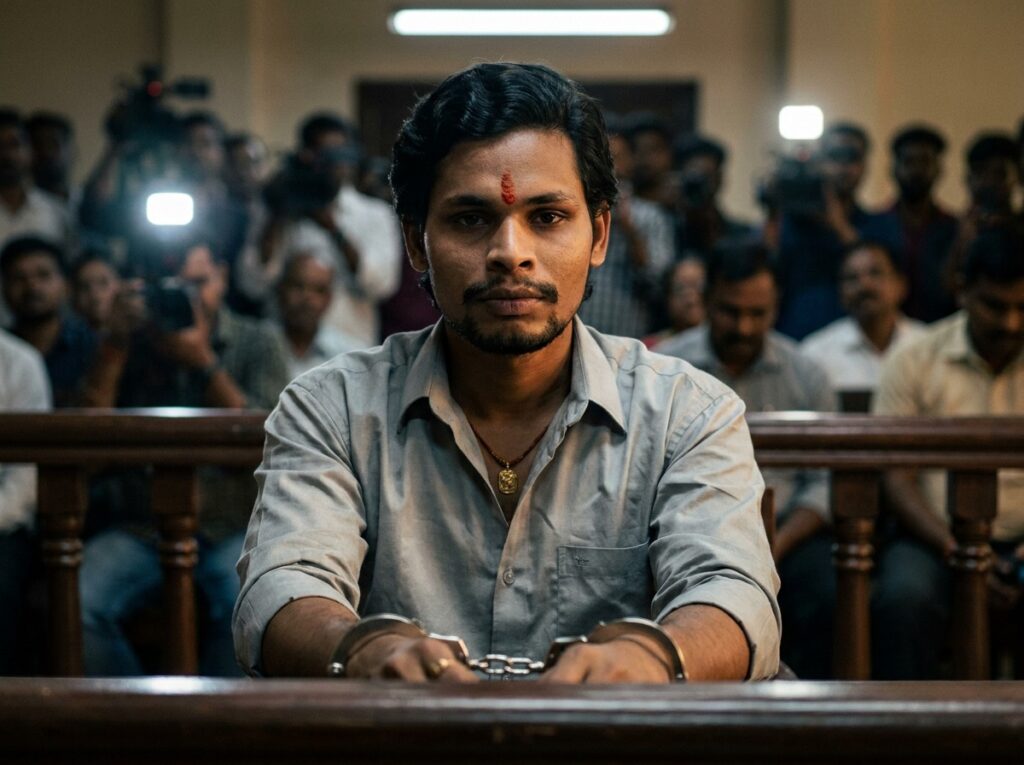
Either way, it was the largest youth demonstration in the capital in years. By the end of the day, Dipke had been detained. Jantar Mantar was cleared. The government confirmed it would file an FIR against the protesters.
And yet, hours before the tear gas, something else had happened. The government reached out. CJP spokespersons Saurav Das and Ashutosh Ranka were taken to meet J.P. Nadda, the BJP president and a senior cabinet minister.
The talks produced no concession. The demands remained unchanged: Pradhan’s resignation, education reform, accountability for exam paper leaks.
But that the government felt compelled to open a channel to a satirical movement born from a joke three months earlier tells you something about the political terrain this march has altered.

A short walk, a long shadow
One and a half kilometres. That is all this march was. But that short distance carries a long shadow.
In 1930, Gandhi walked 240 miles from Sabarmati Ashram to the Arabian Sea coast at Dandi. 24 days. 78 marchers to start. Thousands joined along the way.
The target was the British salt tax. The weapon was a handful of salt picked from the beach. The Dandi March didn’t topple the Raj in a day.
But it cracked something. It showed that a population ruled by an empire could, with discipline and nonviolence, force the world to watch. Gandhi chose salt because every Indian understood salt.
It was the most mundane, most essential, most personal thing the state had taxed. The genius was in the symbolism.
The CJP march carries a different kind of symbolism. Its symbol is an insect. A cockroach. The one creature every Indian household has tried to exterminate. The creature that survives. That is the point.
In May 2026, Chief Justice of India Surya Kant, during an open court hearing, likened unemployed young Indians who “don’t get any employment and don’t have any place in a profession” to cockroaches and parasites. It was the kind of remark powerful men make when they forget who is listening.
Abhijeet Dipke was listening. A political communications strategist who had formerly worked with the Aam Aadmi Party, Dipke was studying public relations at Boston University at the time. He saw the outrage online and asked a simple question on X: “What if all cockroaches came together?”
Within days, there was a website. An Instagram handle. Millions of followers. The Cockroach Janta Party, a satirical “people’s party” named as a play on Modi’s Bharatiya Janata Party, was born. It wasn’t a political party. It was a joke that stopped being funny when people started showing up.
The student precedent
Student-led movements have reshaped India before. The pattern is familiar.
In 1974, students in Bihar gheraoed the state legislative assembly on March 18.
They were protesting corruption, inflation, and the arrogance of a Congress government drunk on its own majority.
Jayaprakash Narayan, the veteran socialist who had stayed out of active politics for years, stepped in to lead what became the Bihar Movement, or the JP Movement. He called it Sampoorna Kranti.
Total Revolution. The movement spread from Bihar to Gujarat to the rest of the country.
It rattled Indira Gandhi so deeply that she imposed the Emergency in June 1975, suspending the Constitution, jailing opposition leaders, and censoring the press.
The Emergency lasted 21 months. When elections finally returned in 1977, the Congress was swept out of power for the first time since independence.
The JP Movement began with students. It ended by rewriting India’s political map. But it also left a scar.
The Emergency taught every subsequent government that mass student protests are not just a law-and-order problem. They are a legitimacy problem.
The Assam Movement followed a different arc. From 1979 to 1985, the All Assam Students’ Union led a six-year agitation against illegal immigration from Bangladesh.
It was raw, sustained, and driven entirely by young people who felt the state had abandoned them.
It ended with the Assam Accord, signed with Rajiv Gandhi’s government. The foreigners’ question in Assam remains unresolved decades later.
But the movement proved a student agitation could sustain itself for years and force the central government to the table.
The Delhi precedent
Delhi has seen its own cycles of protest. Each one carries a lesson.
After the gang rape and murder of a 23-year-old woman on a moving bus in December 2012, thousands gathered at India Gate and Jantar Mantar.
The protests were spontaneous, leaderless, and furious. Candlelight vigils. Slogans. Clashes with police. They forced the government to amend criminal law. Stricter punishments. Faster trials. A new definition of consent.
The laws changed. The culture shifted, slowly. But the system that enabled the violence remained largely intact.
The CAA protests of 2019 and 2020 took a different shape. After Parliament passed the Citizenship Amendment Act on December 11, 2019, students at Jamia Millia Islamia and Aligarh Muslim University faced police crackdowns.
In response, Muslim women in Shaheen Bagh, a neighbourhood in southeast Delhi, began a sit-in protest on December 15. They stayed for 101 days. Through one of Delhi’s coldest winters in years, women sat on a road, refusing to move until the CAA was repealed.
The protest was peaceful, leaderless in the traditional sense but organized from within the community. It drew international attention.
And then the pandemic came. On March 24, 2020, Delhi went into lockdown. Police cleared the site. The protesters were arrested or removed. The CAA was never repealed.
Shaheen Bagh taught a hard lesson. A sit-in can draw the world’s attention. But the state can outlast a sit-in.
What makes this march different
Every protest movement in India’s history has carried a specific grievance. The Dandi March targeted salt taxes. The JP Movement targeted corruption.
The Assam agitation targeted illegal immigration. Nirbhaya targeted sexual violence. Shaheen Bagh targeted the citizenship law.
The CJP’s stated demand is the resignation of Education Minister Dharmendra Pradhan over examination paper leaks and irregularities in the NEET and CBSE systems. But the demand has already escalated.
After Sonam Wangchuk was forcibly removed from the protest site on July 18 and taken to Safdarjung Hospital, Dipke raised the stakes. Until that day, the movement wanted Pradhan out. After that day, Dipke demanded Modi’s resignation.
What makes this march different isn’t the demand. It’s the origin. No Indian protest movement of this scale has started as a joke.
The CJP began as satire. A Supreme Court judge called young people cockroaches.
A young man turned it into a party. Millions joined. The name itself is the protest.
By calling themselves cockroaches, these young Indians are doing something that has no precedent in Indian political history.
They are reclaiming a slur used by the highest judicial authority in the land and wearing it as a badge of survival.
This isn’t the JP Movement’s Total Revolution. It isn’t Gandhi’s salt satyagraha. It’s something India hasn’t seen before: a movement that doesn’t take itself seriously enough to be a political party, but takes its cause seriously enough to march on Parliament.
The satire is the shield. The roses are the message. The demand is real.
Then there’s the question of organization. The JP Movement had JP. The Assam agitation had the AASU’s formal structure. Shaheen Bagh had community elders and local organizers.
The CJP has Instagram. The movement is digital-first in a way no previous Indian protest has been.
It was born, mobilized, and escalated on social media, where videos of Wangchuk being whisked away behind white curtains went viral within hours.
The Wangchuk factor
Sonam Wangchuk isn’t a student. He is 59. He’s an engineer, an education reformer, one of India’s most respected climate activists.
He’s from Ladakh, the Himalayan region carved out of Jammu and Kashmir in 2019. He’s widely believed to have inspired Phunsukh Wangdu in “3 Idiots.” His credibility crosses political lines.
Wangchuk began his hunger strike on June 28, 2026, at Jantar Mantar. He was joining the CJP’s demand for Pradhan’s resignation and broader education reform.
On July 18, 20 days into his fast, police entered the protest site in civilian clothes.
They covered the stage with white curtains. They removed Wangchuk and took him to Safdarjung Hospital. They said it was for his own health. His wife, Gitanjali J. Angmo, called it illegal detention. She said he was taken against his will.
Images of the operation spread across social media. The white curtains. The police in plain clothes. A frail man being carried away from a stage where he had sat without food for 20 days.
They bypassed the editorial filter and reached people directly. And they made the state look like it was afraid of a hunger striker.
Three doctoral students from the All India Students Association, Neha, Aameen, and Manish, had joined Wangchuk on the indefinite hunger strike.
When police broke into their tents, protesters pushed them out. The confrontation was brief. The state was no longer just ignoring the protest. It was dismantling it.
Wangchuk, from his hospital bed, posted a handwritten letter on the morning of the march. He said he was feeling fine. His health parameters were normal.
He asked the hospital authorities to let him leave, even temporarily, so he could join the march to Parliament. The hospital wouldn’t let him leave.
His wife has now approached a Division Bench of the Delhi High Court, challenging the single judge’s refusal to transfer Wangchuk to a private hospital of the family’s choosing. The legal battle is separate from the street battle, but both point in the same direction.
The state’s response
Pradhan, the Education Minister whose resignation the movement demands, has dismissed the CJP as a “B-team of disruptive elements” and, on another occasion, as the “B-team of terror groups.”
This isn’t a measured response. It’s the language of a government that has decided to frame dissent as subversion.
Modi hasn’t addressed the protests. He hasn’t held a press conference in over 12 years, the longest any Indian prime minister has gone without facing unscripted questions from journalists. He spoke on the morning of July 20, outside Parliament, before the monsoon session.
He praised a private space company, talked about oil refineries, semiconductor plants, and a hydrogen train. He never mentioned the thousands marching towards the building he was standing in.
The Delhi Police, which reports to the federal Home Ministry and not to the elected Delhi government, deployed hundreds of officers and paramilitary personnel.
They set up multi-layer barricades around Jantar Mantar. They shut down five metro stations.
They posted riot vehicles along every road leading to the protest site. They broadcast warnings on loudspeakers. They cited Section 163 of the BNSS, the colonial-era prohibitory order framework that has survived three changes of name and zero changes of intent.
The CJP had asked for permission to march. The police said no permission had been sought. The CJP said they would walk anyway. The state denies permission.
The protesters march. The state arrests them. The arrests become the story. The story becomes the movement.
By the afternoon, the barricades held. The police used tear gas and baton charges. Dipke was detained.
The crowd dispersed or was dispersed. The government announced it would file an FIR. The cycle completed.
A door opens, briefly
But before the tear gas, there was the meeting. CJP spokespersons Saurav Das and Ashutosh Ranka were taken to meet J.P. Nadda, BJP president and Union Minister, at the government’s initiative.
Das confirmed the outreach on X: “The government had reached out for talks in the morning.” The demands, he said, were unchanged.
The meeting produced no result. Pradhan didn’t resign. The march went ahead.
The police cracked down. But that the government opened a channel to a movement it had previously called a “B-team of terror groups” reveals something the tear gas cannot obscure.
The state is no longer certain that ignoring this movement will make it go away.
The South Asian context
India isn’t happening in isolation. In Bangladesh, a student-led movement toppled Sheikh Hasina’s government in 2024. In Sri Lanka, mass protests drove President Gotabaya Rajapaksa from his residence and out of the country in 2022. In Nepal, youth-driven upheaval has reshaped the political order repeatedly.
India has the largest Gen Z cohort in the world. Hundreds of millions of young people were born between roughly 1997 and 2012. By 2029, every one of them will be eligible to vote.
They have grown up in a country with record youth unemployment, a shrinking space for dissent, and a steady erosion of institutional credibility. They have watched their neighbours rewrite their political futures.
What happens when the largest Gen Z population in the world decides it has had enough? That’s the question this march poses. Not because this march will topple anyone.
It won’t. The barricades held. The police held. Parliament convened. But the march happened.
And it happened on the first day of the monsoon session, when every camera in the country was pointed at the building the marchers were walking towards.
The distance that matters
The Dandi March was 240 miles. It took 24 days. It ended with a man picking up salt from a beach. That single act of defiance sparked nationwide civil disobedience. It didn’t free India.
But it proved that the British Raj could be defied, openly, peacefully, and in full view of the world.
The CJP march was 1.5 kilometres. It never reached Parliament. The barricades stopped it. The tear gas came. Dipke was detained. An FIR was announced.
The protesters sat down on the road, as instructed. Some waved the flag. Some shouted slogans. Some continued the songs they had been singing since dawn.
The distance is not the point. They walked. They walked knowing the police would stop them. They carried roses instead of stones, copies of the Constitution instead of weapons. They sat down when told to sit. They didn’t break.
The JP Movement taught India that student anger can become a national political force. The Assam agitation taught India that a student movement can last six years. Nirbhaya taught India that outrage can change law. Shaheen Bagh taught India that a sit-in can draw the world’s gaze but cannot outlast a determined state.
The CJP march teaches something else. A generation called cockroaches by the Chief Justice of India absorbed the insult, reclaimed it, and turned it into a political identity that brought them to the gates of Parliament on the day the lawmakers convene.
The government called them terrorists. The police fired tear gas. And then the same government quietly sent two of them to meet the BJP president.
Whether it survives the barricades, the arrests, the FIRs, and the inevitable attempt to paint its leaders as agents of foreign powers or terrorists or both, the coming weeks will decide.
Whether it becomes the Dandi March of its generation or a footnote like so many Jantar Mantar protests before it, nobody knows yet.
But on July 20, 2026, for a few hours, a group of young Indians who call themselves cockroaches walked towards the building where India’s laws are made.
They carried roses. They carried the Constitution. They were stopped. They sat down. The cameras kept rolling. The government reached out. The tear gas came. The FIR came.
That’s how it begins. Not with a bang. Not with a slogan. With a rose and a barricade and a generation that refuses to be exterminated.
Sources
Al Jazeera (news report and live coverage, July 20, 2026); The Hindu (live coverage and route description, July 20, 2026); Deutsche Welle (live coverage, July 20, 2026); BBC News (live coverage, July 20, 2026); ETV Bharat (live blog, Nadda meeting, July 20, 2026); WION (Dipke detention report, July 20, 2026); Wikipedia (2026 Delhi Jantar Mantar protests; Cockroach Janta Party); New Indian Express (Pradhan “B-team” quote, June 24, 2026); The Print (Dipke background); American Bazaar (Dipke US departure, June 5, 2026); Britannica (Salt March; Jayaprakash Narayan; Assam Agitation); Frontline/The Hindu (JP Movement coverage); Swarthmore College Global Nonviolent Action Database (Nirbhaya protests); Wikipedia (Shaheen Bagh protest; Citizenship Amendment Act protests; Assam Movement; Bihar Movement); Economic Times (Delhi Police FIR clarification, June 6, 2026); Free Press Kashmir (Nadda meeting, July 20, 2026).