India Deploys Nuclear Warheads for First Time: What SIPRI Yearbook 2026 Reveals
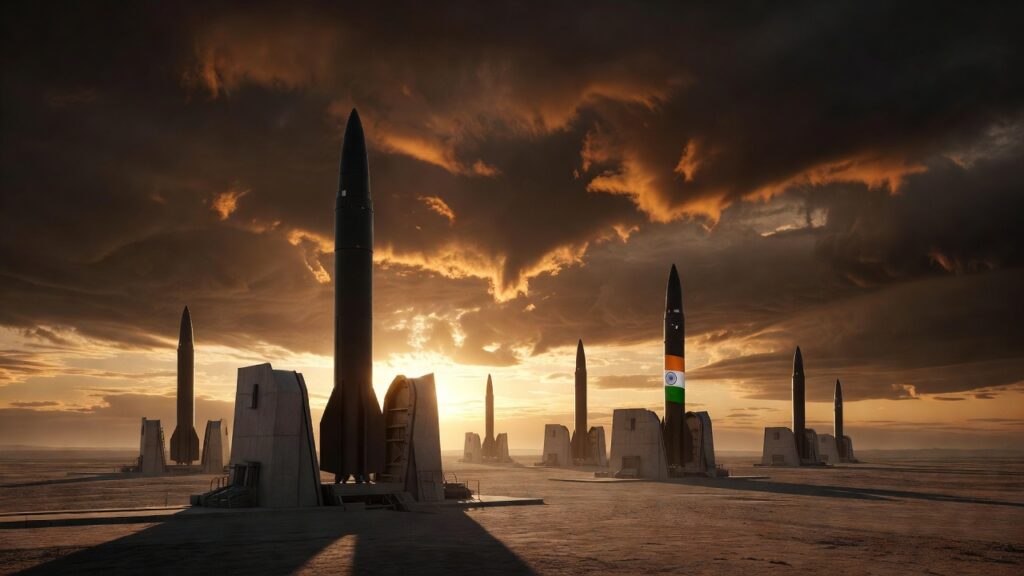
India has operationally deployed nuclear warheads for the first time in its history. Twelve warheads are now mounted on delivery platforms during peacetime — a strategic shift that breaks with decades of deliberate ambiguity and warhead-weapon separation.
The finding comes from the Stockholm International Peace Research Institute’s Yearbook 2026, released on June 8, which also estimates India’s total nuclear arsenal has grown to approximately 190 warheads. And for the first time, the country has entered the top five global military spenders, with a defence expenditure of $92.1 billion in 2025.
Here is what the data reveals about India’s military rise — and what it means for the strategic landscape.
The nuclear numbers: India widens the gap
According to SIPRI, India’s nuclear stockpile stands at an estimated 190 warheads as of January 2026, up from 180 a year earlier. Pakistan’s arsenal remains at approximately 170 warheads — stable for the third consecutive year.
That gives India a lead of about 20 warheads, a gap that has steadily widened as New Delhi continues to produce fissile material and develop new delivery systems.
Globally, the nine nuclear-armed states — the United States, Russia, the United Kingdom, France, China, India, Pakistan, North Korea and Israel — together possess approximately 12,187 nuclear weapons. Of those, 9,745 are in military stockpiles and considered potentially available for use. The United States and Russia together account for roughly 83 per cent of all stockpiled warheads.
| Country | Total Warheads | Deployed |
|---|---|---|
| Russia | 5,420 | 1,796 |
| United States | 5,042 | 1,770 |
| China | 620 | 34 |
| France | 370 | 280 |
| United Kingdom | 225 | 120 |
| India | 190 | 12 |
| Israel | 90 | 0 |
| North Korea | 60 | 0 |
| Pakistan | 170 | 0 |

The big strategic shift: from stockpiled to deployed
India’s 12 deployed warheads represent a fundamental policy change. For decades, the country followed a policy of keeping warheads and delivery systems stored separately — a posture known as “de-mated” — as a deliberate restraint mechanism. SIPRI now estimates that India may have begun mating some warheads with their launchers during peacetime.
“This is the first time SIPRI’s nuclear weapons tracking report has indicated that India has deployed nuclear warheads,” the report notes. In all previous editions, India’s arsenal was classified entirely as “stockpiled” — stored but not mounted on operational platforms.
The shift is tied specifically to India’s sea-based deterrent. SIPRI assesses that India deployed warheads on a single nuclear-powered ballistic missile submarine (SSBN) conducting occasional deterrence patrols.
This places India in a small club of nations that maintain at-sea nuclear deterrence — a capability only the United States, Russia, the United Kingdom, France and China have traditionally held.
SIPRI also notes that India’s modernization is increasingly focused on long-range weapons capable of reaching targets throughout China, though planning remains heavily influenced by the long-standing rivalry with Pakistan.
The report specifically references the brief India-Pakistan armed conflict in May 2025 — Operation Sindoor — noting that India attacked Pakistani air and missile bases “that are likely to have nuclear-related roles” while “both sides took steps to avoid escalation.”
$92.1 billion: India enters the top five
India’s military expenditure reached $92.1 billion in 2025, an 8.9 per cent jump from the previous year. That makes India the fifth-largest military spender in the world, behind the United States ($954 billion), China ($336 billion), Russia ($190 billion) and Germany ($114 billion).
The spending spike was significantly influenced by Operation Sindoor. Revised capital outlays for military aircraft systems were 50 per cent higher than originally budgeted. Operations and personnel costs for the Indian Air Force were revised upwards by 18 per cent.
By comparison, Pakistan’s military spending stood at $11.9 billion in 2025 — roughly one-eighth of India’s expenditure.
| Rank | Country | Military Spend (2025) |
|---|---|---|
| 1 | United States | $954 billion |
| 2 | China | $336 billion |
| 3 | Russia | $190 billion |
| 4 | Germany | $114 billion |
| 5 | India | $92.1 billion |
Global military spending at record high
India’s rise is part of a bigger global picture. Worldwide military expenditure hit $2,887 billion in 2025 — the 11th consecutive year of increase and the highest level ever recorded. The global military burden, measured as military spending as a share of GDP, reached 2.5 per cent, its highest mark since 2009.
Across Asia and Oceania, military expenditure rose by 8.1 per cent to $681 billion — the biggest annual increase since 2009. Japan’s spending climbed 9.7 per cent to $62.2 billion, its highest military burden since 1958. Taiwan saw the largest year-on-year increase in the region, with expenditure rising 14 per cent to $18.2 billion.
What it means for India
The SIPRI data arrives at a pivotal moment for India’s strategic calculus. New Delhi faces a two-front security environment — a nuclear-armed China pursuing rapid military modernisation to its north and east, and a Pakistan that has responded to the May 2025 conflict by deepening its procurement ties with Beijing.
China’s nuclear arsenal has reached an estimated 620 warheads — more than three times India’s stockpile. Beijing also increased its deployed warheads from 24 to 34, suggesting it too is moving toward higher operational readiness.
SIPRI’s press release carries a sober warning from Hans M. Kristensen, associate senior fellow and director of the FAS Nuclear Information Project: “The evidence is growing that the nuclear weapon states are sidelining, and even walking away from, their disarmament commitments and are instead flexing their nuclear muscles. By reaching for nuclear solutions, states are creating new risks and fuelling arms-race dynamics.”
Key takeaways
- India has deployed 12 nuclear warheads on launchers for the first time, marking a historic shift from a de-mated posture to active operational deployment
- India’s total nuclear arsenal stands at 190 warheads, ahead of Pakistan’s 170
- China remains the dominant regional nuclear power with 620 warheads
- India became the world’s fifth-largest military spender at $92.1 billion in 2025, driven by the May 2025 conflict with Pakistan
- Global military expenditure hit a record $2.887 trillion, the 11th consecutive annual increase
- SIPRI warns that nations are “flexing their nuclear muscles” and creating new arms-race dynamics