The US Banned Its Own AI From India. Now What?
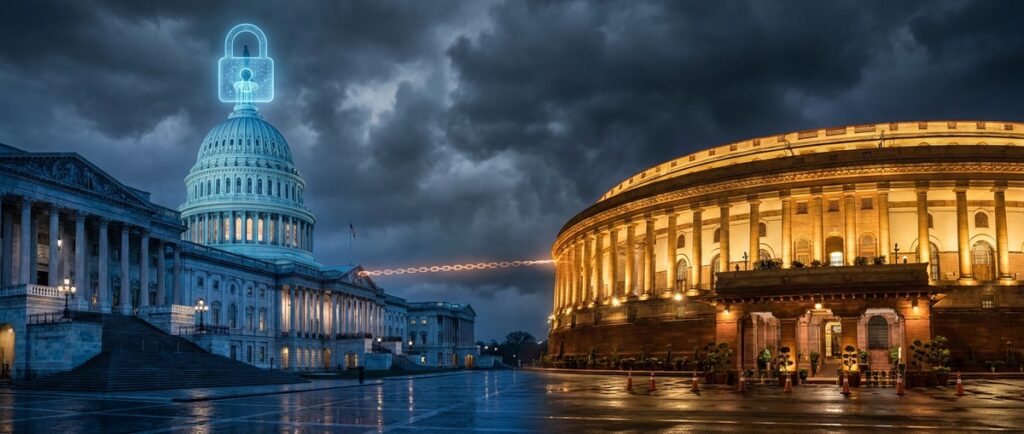
On June 12, 2026, at 5:21 PM ET, the US Commerce Department sent Anthropic an export control directive. It ordered the company to cut off all foreign access to Fable 5 and Mythos 5, its two most advanced AI models.
The restriction covers users outside the US as well as foreign nationals inside the US, including Anthropic’s non-citizen employees.
Anthropic disabled both models globally within hours.
Anthropic said the government did not specify the details of the national security concern. The company estimates the government identified a narrow potential jailbreak that bypassed Fable 5’s safeguards to reach Mythos 5’s cybersecurity capabilities. Anthropic argues the same jailbreak method works on OpenAI’s GPT-5.5, which is not under similar restrictions, and that these methods are routinely used by security professionals.
The company is challenging the order and working to restore access.

Anthropic disabled Fable 5 and Mythos 5 globally after the US Commerce Department ordered foreign access cut off
This action follows months of escalating conflict between Anthropic and the Trump administration. In 2024, Anthropic refused to sign Pentagon contracts that would allow military use of its AI for “any lawful purpose,” including autonomous weapons and mass surveillance. The Pentagon designated Anthropic a “supply chain risk” in March 2026.
Federal agencies were banned from using Anthropic products in April 2026.
| Models affected | Fable 5 (general purpose), Mythos 5 (cybersecurity) |
| US claim | Narrow jailbreak bypassed Fable 5 to access Mythos 5 |
| Anthropic response | Same method works on GPT-5.5; this is a misunderstanding |
| Not affected | Claude Opus 4.8, Claude Sonnet, older models |
| Current status | Both models disabled. Restoration timeline unclear. |
| Political context | Ongoing Trump-Anthropic conflict since 2024 Pentagon contract refusal |
India’s Exposure
India accounts for 5.8% of global Claude.ai usage, second only to the United States, according to Anthropic’s Economic Index. Indian developers and enterprises use Claude heavily for professional and technical work.
Under Project Glasswing, Anthropic gave early Mythos 5 access to about 150 organizations across 15 countries, including India. India sat alongside NATO and Five Eyes members in this cybersecurity initiative. That access is now cut.
India’s AI ecosystem runs on US foundation models. OpenAI’s GPT family dominates enterprise and consumer applications. Anthropic’s Claude and Mythos serve safety-critical and cybersecurity use cases.
Google’s Gemini handles Indic language tasks. Meta’s Llama, the only open-weight option, is the main alternative. Mistral from France is growing but remains a niche in India.
Only Llama is truly open-weight. All others are proprietary, hosted on US servers, and subject to US export law. What happened to Anthropic today can happen to any of them.
The US AI Diffusion Framework from January 2025 already split the world into three tiers for AI chips. Close allies get unrestricted access. Adversarial nations are blocked.
The middle tier, where India sits, faces licensing and caps. The Anthropic action extends this control from chips to models.
The Capability Gap
At the India AI Impact Summit 2026, held in February at Bharat Mandapam in New Delhi, India unveiled 12 indigenous foundation models under the IndiaAI Mission. Sarvam AI showed Sarvam-30B and Sarvam-105B, a mixture-of-experts model with a 128K context window. Soket AI Labs released a 120B parameter, open-source model.
BharatGen, run by an IIT Bombay consortium, covers 22 languages. Gnani.ai built a voice-first conversational AI. BrahmAI targets scientific computation.
Intellihealth.ai focuses on healthcare diagnostics. Tech Mahindra released a Hindi-first education LLM.
These models are genuine achievements. But the largest Indian model, Sarvam-105B, is roughly two generations behind what Anthropic just shut down. Mythos 5 and Fable 5 operate at a frontier capability level that India’s ecosystem combined cannot yet match.
| Frontier LLM (>100B params) | GPT-5.5, Fable 5, Mythos 5, Gemini 3 | DeepSeek-V4, Qwen 3.5, Ernie 5 | Sarvam-105B MoE, unproven at the frontier |
| Cybersecurity specialist | Mythos 5 (blocked) | Limited | None |
| Multilingual 22+ languages | Poor | None | BharatGen, Sarvam |
| Voice-first Indian accents | Poor | None | Gnani.ai, Gan AI |
| Open-source frontier | Llama 5 | DeepSeek open models | LLM Param-2 BharatGen |
| Compute infrastructure | 500K+ H100 equivalents | 300K+ equivalents domestic chips | ~38,000 GPUs shared |
The Compute Gap
The IndiaAI Mission has a $1.2 billion budget. It deployed about 38,000 GPUs, up from the original 10,000 target, and offered them at a subsidized rate of 65 rupees per hour. Partners include NVIDIA, Yotta, L&T, and E2E Networks.
Meta’s Llama 5 trained on roughly 100,000 H100 GPUs. DeepSeek-V4 was trained on a cluster of about 50,000 equivalent GPUs. India’s entire pool is 38,000 GPUs, shared across academia, startups, MSMEs, and government agencies.
The government says India will produce its own GPUs in 3 to 5 years through the India Semiconductor Mission. The IndiaAI Mission 2.0 targets 20,000 additional GPUs. For frontier model training, India remains compute-constrained.
Six Areas of Impact
Economic: Indian Startups Face Disruption
Startups that built products on Anthropic’s API face immediate disruption. Those using Mythos 5 for cybersecurity lost their core capability. SaaS products using Anthropic’s API must find replacements.
Indian cybersecurity startups that relied on Mythos access lose their competitive edge. Enterprise AI projects with Anthropic at the core face replatforming costs. Investor confidence in API-layer startups may cool.
The message to Indian venture capital is direct: building on American foundation models is a lease, not a moat. Leases get revoked.
Geopolitical: The India-US Technology Partnership
India and the United States signed a strategic technology partnership in February 2026 covering AI, semiconductors, and defense innovation. India sits in the middle tier of the AI Diffusion Framework, not in the inner circle of trusted allies. India was excluded from unrestricted AI chip access under Biden-era rules.
The Anthropic ban hits Indian users exactly the same way it hits users from adversarial nations.
The US treats allies and adversaries as a single foreign category for frontier AI access. This gives India a strong incentive to accelerate sovereign AI and explore alternative partnerships.
National Security: A Cybersecurity Gap
India’s inclusion in Project Glasswing was a milestone. Indian organizations sat alongside NATO and Five Eyes for AI-powered vulnerability detection. That access is gone.
Indian critical infrastructure that used Mythos 5 for zero-day detection has lost that capability. Government cyber defense agencies no longer have access to the tool. Adversarial nations continue building their own AI-powered cyber capabilities.
Talent: Career Uncertainty for Indian Researchers
Gary Marcus warned the Anthropic action will push Chinese-born AI researchers back to China. Indian AI talent at Anthropic, OpenAI, and Google faces similar uncertainty. India has 16% of the worlds AI talent.
Most of it works for American companies. A regulatory environment that treats foreign nationals as security risks changes where talent chooses to go.
Open Source: A Strategic Necessity
The Anthropic ban makes the case for open-weight foundation models. Meta Llama 5, DeepSeek open models, and India’s BharatGen cannot be switched off because they run on user-owned infrastructure. Every rupee spent on indigenous foundation models is insurance against future export controls.
The IndiaAI Mission requirement that funded models be open source is strategically correct.
Global South: India’s Leadership Opportunity
The Anthropic ban affects every non-US country equally. A coalition of affected nations shares common interests: multilateral governance against unilateral model shutdowns, investment in sovereign AI infrastructure, open-source ecosystems not controlled by one government, and shared compute resources among middle powers. India hosted the AI Impact Summit and has committed $1.2 billion to AI.
It is positioned to lead this coalition.
India’s Existing Policy
IndiaAI Mission (March 2024)
Budget: 10,000 crore rupees ($1.2 billion). Compute: 38,000 GPUs at 65 rupees per hour. Open the GPU Marketplace for equitable access.
AIKosh datasets platform. IndiaAI Innovation Centre for indigenous LLMs.
AI Governance Guidelines (February 2026)
Seven Sutras for safe AI. Techno-legal framework blending technical standards with legal backstops. Sector-specific regulatory sandboxes.
Digital Public Infrastructure integration with AI.
India AI Impact Summit 2026
Twelve indigenous foundation models. Global participation from Macron, Sundar Pichai, Sam Altman, and Demis Hassabis. Focus on multilingual, voice-first, culturally-grounded AI.
India Semiconductor Mission
Domestic GPU production target in 3 to 5 years. 76,000 crore rupees ($9 billion) incentive scheme. Strategic partnership with the US on chip supply chains.
Recommendations
Immediate (next 6 months)
Fast-track IndiaAI Mission 2.0’s 20,000 additional GPUs. Provide subsidized migration from Anthropic-dependent products to indigenous or open-source models. Pool affected organizations into a national cybersecurity AI research consortium.
Push diplomatically for AI export control exemptions as a trusted US ally.
Medium-term (6 to 18 months)
Train a frontier Indian foundation model exceeding 200 billion parameters. Build India-specific cybersecurity AI with Indian threat domain expertise. Deepen the India-France-Japan-UAE AI alliance for shared compute and joint training.
Establish legal reciprocity for AI safety standards. Expand the open GPU marketplace to include government-grade compute.
Long-term (2 to 5 years)
Produce India’s first domestic AI accelerator through the Semiconductor Mission. Make India the default destination for non-US, non-China AI talent. Lead the Global South AI governance agenda at the UN.
Champion a Model Sovereign Trust framework with international agreements against unilateral model shutdown.
Key Data Points
India’s share of global Claude.ai use: 5.8% (second globally). IndiaAI Mission budget: 10,000 crore rupees ($1.2 billion). GPUs deployed: 38,000.
Indigenous models unveiled: 12. Largest Indian LLM: Sarvam-105B MoE. India’s share of global AI talent: 16%.
Public GenAI projects on GitHub: second globally. GPU subsidy rate: 65 rupees per hour. Domestic GPU target: 3 to 5 years.
Anthropic pre-IPO valuation: $965 billion. Mythos 5 restoration: unknown, estimated weeks. US allies treated the same as adversaries: yes.
—
Sources: Fortune, WSJ, Chosun Ilbo, Reuters, Anthropic official statements, Government of India press releases, IndiaAI portal, NITI Aayog, and NVIDIA blog.